Article: How to Choose a Rosary for Daily Prayer

How to Choose a Rosary for Daily Prayer
When choosing a rosary, it helps to first think about how it will be used.
Will it stay at home in a prayer space? Will it be carried every day? Is it being purchased as a gift, kept as a meaningful keepsake, or passed down as an heirloom?
Each of these factors plays an important role in deciding which rosary might be appropriate. A rosary kept beside a Bible may have different priorities than one carried in a pocket, purse, or backpack each day.
There is no single rosary that is right for everyone. The best choice is one that feels comfortable to use, reflects a meaningful devotion, and fits the way the owner intends to pray with it.
Cord vs. Chain
One of the first decisions is whether to choose a cord or chain rosary.
Chain is a beautiful and traditional construction style. It is flexible, moves easily in the hand, and is available in a wide range of materials, designs, and quality levels.
Most modern chain rosaries are made by placing each bead onto a piece of wire or an eye pin. The wire is then formed into a loop and connected to the next bead. This gives the rosary its familiar movement and spacing.
The gauge and hardness of the wire play an important role in durability. Thicker wire is generally more resistant to bending, though it may also look heavier or be difficult to use with beads that have smaller holes.
Because each bead is joined through an individual wire loop, chain rosaries contain many separate connection points. A properly made chain rosary can be very durable, but its strength depends on the wire gauge, metal hardness, loop construction, chain, and jump rings used.
Some wire-linked rosaries use simple loops, while others use wrapped loops. Wrapped loops are typically more secure because the wire is wound around itself rather than simply bent closed.
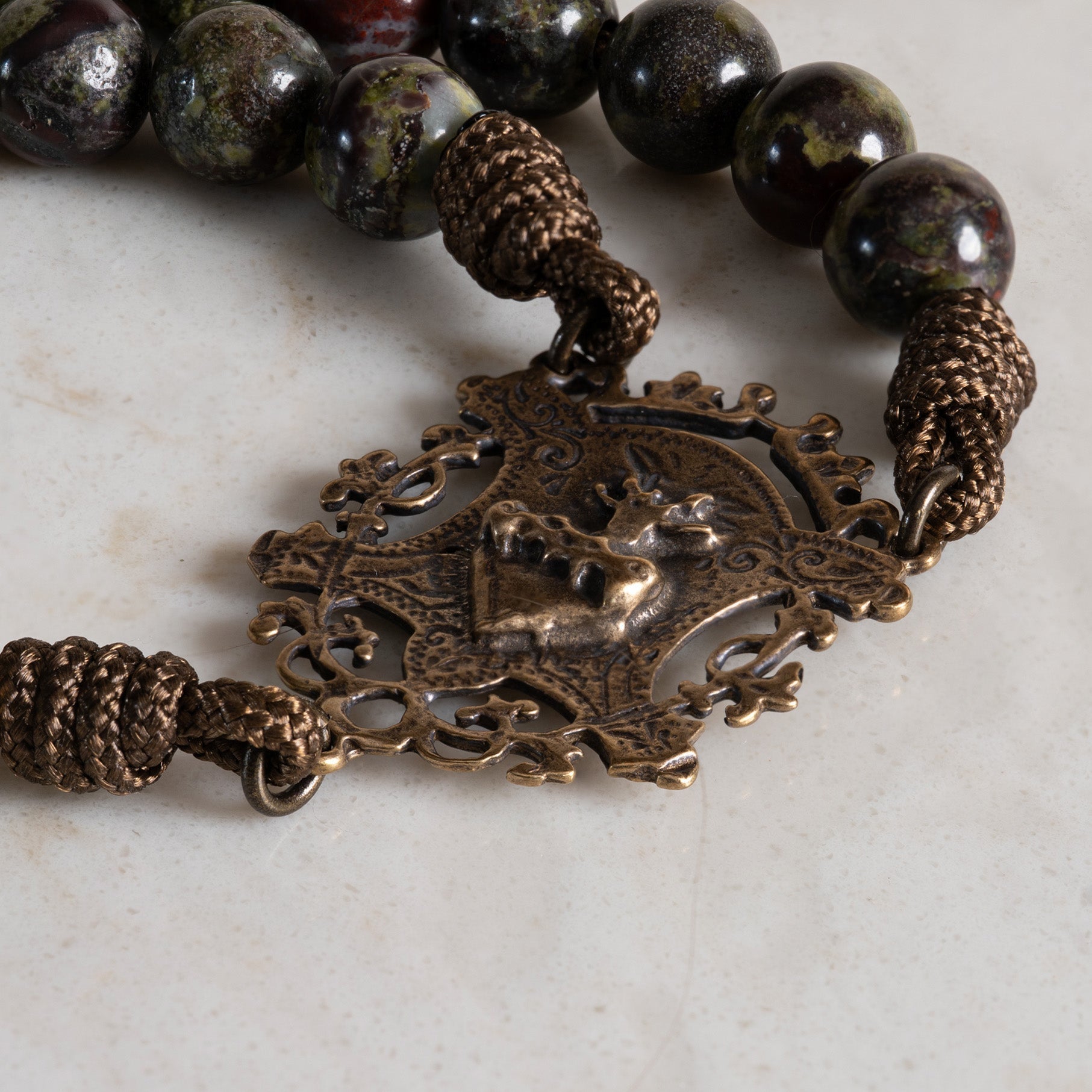
Cord rosaries are generally designed with durability and regular handling in mind. They are often made with paracord or another strong braided cord that runs continuously through the beads.
Paracord has high tensile strength, though the durability of the finished rosary also depends on the knots, bead holes, metal connections, and overall construction.
Because there is not a separate wire connection between every bead, cord rosaries have fewer potential opening points throughout the decades. They are generally well suited to frequent handling, carrying, and the minor pulling or snagging that can happen during daily use.
Cord is less traditional in appearance than fine metal chain, but it creates a rosary that is flexible, substantial, and comfortable in the hand. It can also work especially well with heavier materials such as natural gemstone beads.
Neither style is indestructible. Cord can eventually abrade, while metal loops and jump rings can bend or open. The main difference is how the rosary is constructed and where stress is placed during use.
Read our full comparison:
Cord vs. Chain Rosaries: Why We Choose Durable Cord
Wood vs. Gemstone
The material used for the beads has a major effect on the appearance, weight, texture, and cost of a rosary.
Wood Beads
Wood is commonly used in both cord and chain rosaries. It is natural, lightweight, and comfortable in the hand. Wood can also keep the total cost of a rosary lower because the beads are often less expensive than natural gemstones.
Wood is a good choice for someone who wants a rosary that is easy to carry and does not feel heavy during prayer. Different types of wood can provide warm brown, red, black, cream, or olive tones, though the natural color range is generally more limited than gemstone.
Painted or dyed wood can create a wider variety of colors, but those finishes may scratch or wear over time. Natural wood may also absorb moisture, skin oils, or other substances if it is not properly sealed.
Because wood responds to moisture and humidity, unfinished or poorly sealed beads may discolor, swell, shrink, or develop small cracks over time.
Wood beads may be less likely than some gemstone beads to chip when dropped, but their durability still depends on the species, grain, finish, and quality of the bead.
Gemstone Beads
Natural gemstone beads are available in a much wider range of colors, patterns, and visual textures. Jasper, agate, obsidian, quartz, onyx, pietersite, and many other stones can each give a rosary a very different appearance.
The durability of a gemstone is not determined by hardness alone.
Hardness measures how resistant a stone is to scratching. Toughness describes how resistant it is to chipping, cracking, or breaking from impact.
A gemstone can be very hard but still have an internal structure or cleavage that makes it vulnerable when struck at the wrong angle. Diamond is the best-known example. It is extremely resistant to scratching, but it can still chip or fracture under a hard impact.
Jasper and many varieties of agate are popular choices for rosaries because they generally offer a useful balance of hardness, toughness, color, and availability. As with any natural material, durability can still vary from bead to bead.
Natural gemstones may contain small inclusions, veins, changes in color, or differences in pattern. These characteristics are part of the stone rather than flaws in the finished rosary.
Even beads cut from the same type of stone can look noticeably different. This means that two rosaries made from the same materials may not be exact copies of one another.
For many people, that natural variation is part of the appeal. Each rosary has its own character.
Gemstones are also heavier than most wood, acrylic, or plastic beads. Some people appreciate that substantial feeling during prayer, while others may prefer something lighter.
Size and Weight
Rosary beads are commonly measured in millimeters. The measurement usually refers to the diameter of a round bead.
Common sizes include:
- 6 mm
- 8 mm
- 10 mm
Six-millimeter beads create a compact, lightweight rosary. They are useful for pocket rosaries and designs where portability is the main priority. Some people may find them harder to distinguish by touch than larger beads.
Eight-millimeter beads provide a comfortable middle ground. They are large enough to feel clearly in the hand without making the entire rosary excessively heavy.
Ten-millimeter beads feel more substantial and can make the Our Father beads easier to identify. They also increase the overall size and weight of the rosary, especially when natural gemstones are used.
Some rosaries combine sizes, such as 8 mm Hail Mary beads with 10 mm Our Father beads. This creates a clear tactile difference between the decades and gives the design more visual structure.
The right size often comes down to personal preference. Someone with larger hands, limited dexterity, or difficulty feeling small beads may appreciate a larger design. Someone who wants a rosary that fits easily into a pocket may prefer smaller beads.
Weight matters as well.
A heavier gemstone rosary may feel substantial and grounding during prayer, but it may be less comfortable to carry in a shirt pocket. A lighter wood rosary may be easier to carry throughout the day, though it will not have the same weight in the hand.
The Crucifix and Centerpiece
The crucifix and centerpiece often carry much of the devotional character of a rosary.
A centerpiece may depict the Blessed Virgin Mary, the Sacred Heart of Jesus, a saint, or another image connected to Catholic devotion. The crucifix may be simple and traditional or highly detailed.
These pieces can influence which rosary a person naturally feels drawn toward.
Someone with a strong devotion to the Sacred Heart may find greater meaning in a rosary built around that image. Another person may prefer the Miraculous Medal, Saint Michael, Our Lady of Sorrows, or a Marian title that has played an important role in their faith.
The material used for the crucifix and centerpiece also affects the appearance, weight, durability, and way the rosary ages.
Plated metals are typically more affordable and can provide the appearance of silver, gold, or bronze. The finish may eventually wear through if the piece is scratched or handled frequently.
Pewter can hold a high level of detail and has a traditional silver-gray appearance. It is softer than bronze and may be more vulnerable to bending, denting, or scratching in thin areas.
Solid bronze has more weight, warmth, and resistance to deformation. It also develops a natural patina over time, usually darkening into deeper brown tones.
The attachment loops are worth examining as well. Even a well-cast crucifix can become a weak point if the loop is very thin or connected with an undersized jump ring.
For a rosary that will be carried often, look for devotional pieces that are detailed without being overly delicate. Thin projections and narrow loops may be more vulnerable to bending or snagging.
Read more:
Why We Use Solid Bronze in Our Heirloom Rosaries
Consider How the Rosary Will Be Used
A rosary kept at home does not need to meet the same requirements as one carried every day.
For home prayer
A rosary kept in a prayer space can be larger, heavier, or more ornate because portability is less important.
This may be a good use for:
- heavier gemstone beads
- larger crucifixes
- more detailed metalwork
- longer rosaries
- heirloom pieces
For daily carrying
A rosary carried every day should balance durability, weight, flexibility, and size.
Consider:
- overall length
- bead weight
- resistance to snagging
- strength of the cord or wire
- connection points
- whether it comes with a protective pouch
A pouch can help protect the beads, crucifix, and centerpiece from keys, coins, and other objects inside a bag. It can also help prevent tangling.
It is also better to lift a rosary by the beads or main body rather than repeatedly pulling it by the crucifix.
For an heirloom
A rosary intended to be handed down should use materials and construction that can age well and be repaired if needed.
That does not mean the piece must remain visually unchanged. Bronze may develop a patina, silver may tarnish, wood may darken, and cord may soften slightly with use.
These changes can become part of the history of the rosary.
Repairability is also important. A devotional object intended for years of prayer should not automatically become disposable if a connection or component eventually needs attention.
Can the Rosary Be Worn?
Not every five-decade rosary is designed or sized to be worn around the neck.
The overall circumference depends on:
- bead size
- spacing
- chain length
- knot placement
- centerpiece size
- construction style
Some chain rosaries are intentionally made longer and may fit comfortably over the head. Tightly constructed cord rosaries may have a smaller circumference even when they contain the same number of beads.
If wearability is important, check the total length or circumference rather than assuming that every full rosary will fit.
A rosary should also be worn with respect and not treated only as jewelry.
Choosing a Rosary as a Gift
When purchasing a rosary for someone else, consider how familiar they are with the devotion and how they are likely to use it.
A lightweight rosary may be a good choice for someone new to praying the Rosary or for a person who prefers something easy to carry.
A more substantial gemstone and bronze rosary may be appropriate for a wedding, Confirmation, anniversary, reception into the Church, ordination, or another important occasion.
Devotional meaning may be more important than color alone. Consider whether the recipient has a connection to:
- a particular saint
- the Sacred Heart
- the Blessed Virgin Mary
- a Marian title
- a sacramental milestone
- a loved one or family tradition
When that information is not known, a classic design with a traditional crucifix and Marian centerpiece is usually a safe choice.
The recipient’s personal style can also help guide the decision. Some people prefer dark, understated materials, while others are naturally drawn to brighter gemstones or more ornate metalwork.
Craftsmanship and Construction
Materials matter, but construction matters just as much.
A strong material can still perform poorly if the connections are undersized, the knots are loose, or the wire loops are not fully closed.
When evaluating a rosary, look beyond the names of the materials and pay attention to how the entire piece is assembled.
Things to consider include:
- consistency of the loops or knots
- wire thickness
- cord condition
- secure centerpiece and crucifix connections
- smooth edges
- even bead spacing
- balanced weight
- overall flexibility
A handmade rosary may show small differences from one piece to another. That is normal.
What matters is that those differences reflect hand craftsmanship rather than weak or careless construction.
There Is No Single Best Rosary
The best rosary is not always the most expensive, the heaviest, or the most ornate.
It is the one that supports prayer and feels natural enough to use regularly.
Some people prefer the light movement and traditional appearance of chain. Others value the durability and substantial feel of cord and gemstone. Some are drawn to a particular devotion, while others choose a rosary because of its color, weight, or connection to an important moment in their life.
At San Giovanni Cord & Stone, we build rosaries with natural gemstones, durable cord, and carefully selected devotional pieces because that combination reflects what we value most: beauty, strength, and regular use.
A rosary should be meaningful enough to treasure, but it should also be made to be held, carried, and prayed with.